
Sustainable Armband
CHALLENGE
Our goal for this project was to identify a convenient and environmentally sustainable way for runners, power-walkers, and hikers to carry things while on the move. Broadly, our ideal intended audience for our product was people who lead an active lifestyle. Ultimately, we wanted to generate a solution to answer the overarching question, “Which items do these people need most throughout their activities, why those items, and can we introduce sustainable features into the design of these items?”
TYPE
UX
ROLE
Project Management
Research
Information
Usability Tests
Prototype Mockup
CREDITS
Jacob Cohen, Aviva Moshman, Jack Ramos, and Jooyong Song
RESEARCH
Since our goal was to identify a convenient and environmentally sustainable way for runners, power-walkers, and hikers to carry things while on the move, we needed to understand which items, functionalities, and behaviors they need and exhibit while conducting their activities. Ultimately, we wanted to answer the question, “Which items do these people need most throughout their activities, why those items, and can we introduce sustainable features into the design of these items?”
Participants
Our team interviewed 19 individuals who participated in outdoor activities such as walking, running, and hiking during our first round of research. Ten of our participants partook in the running category, 12 in walking and 7 in hiking.
Our audience consists of these user personas.
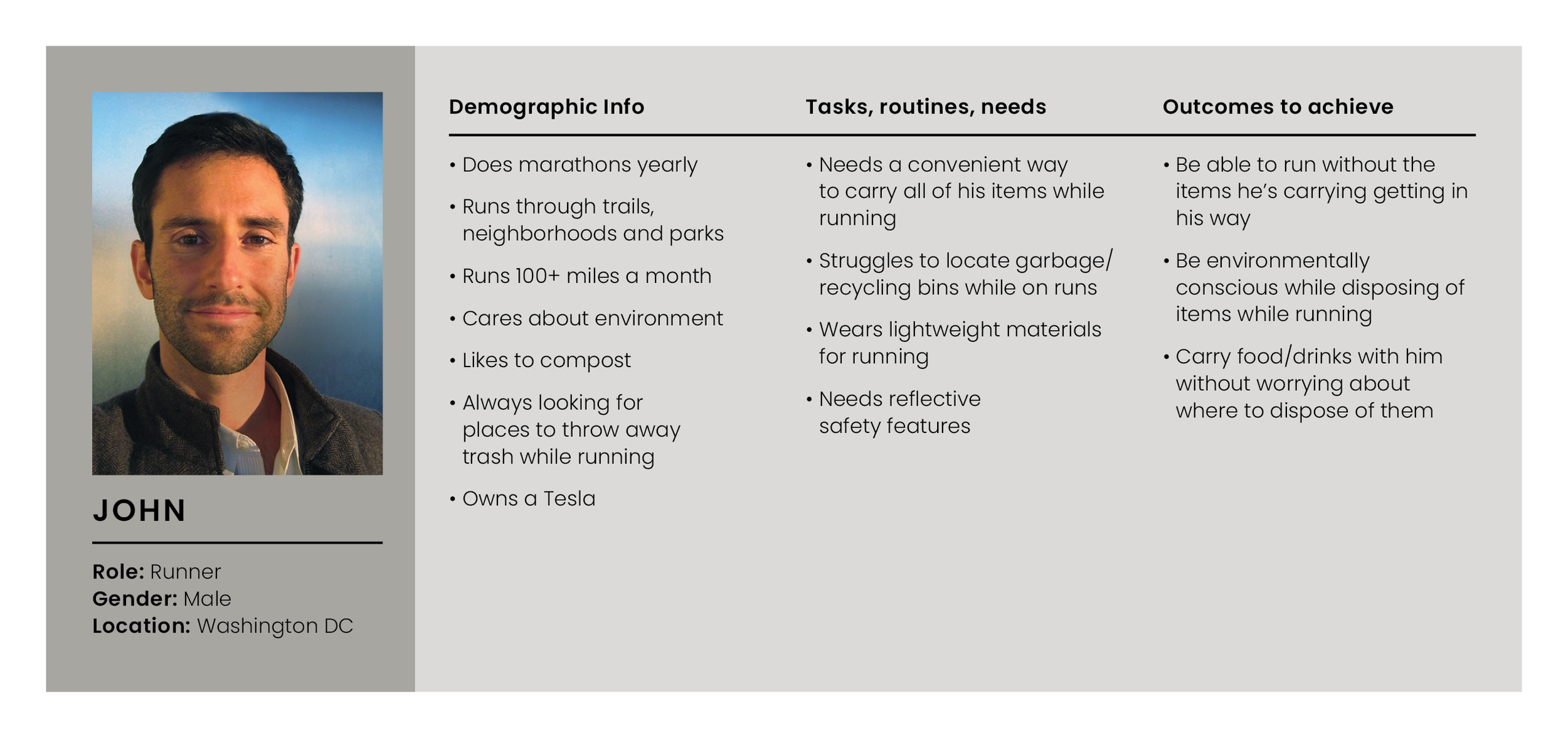
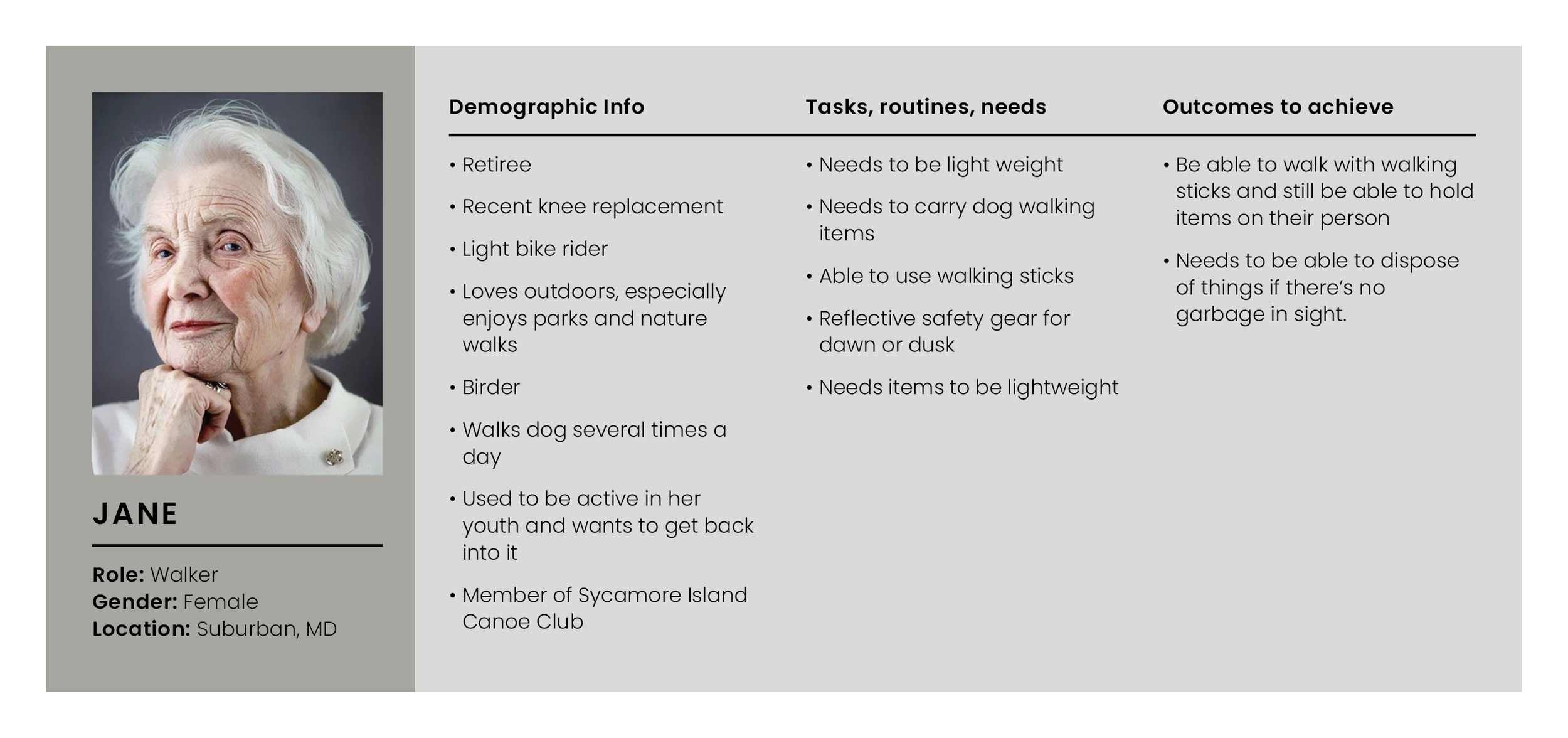
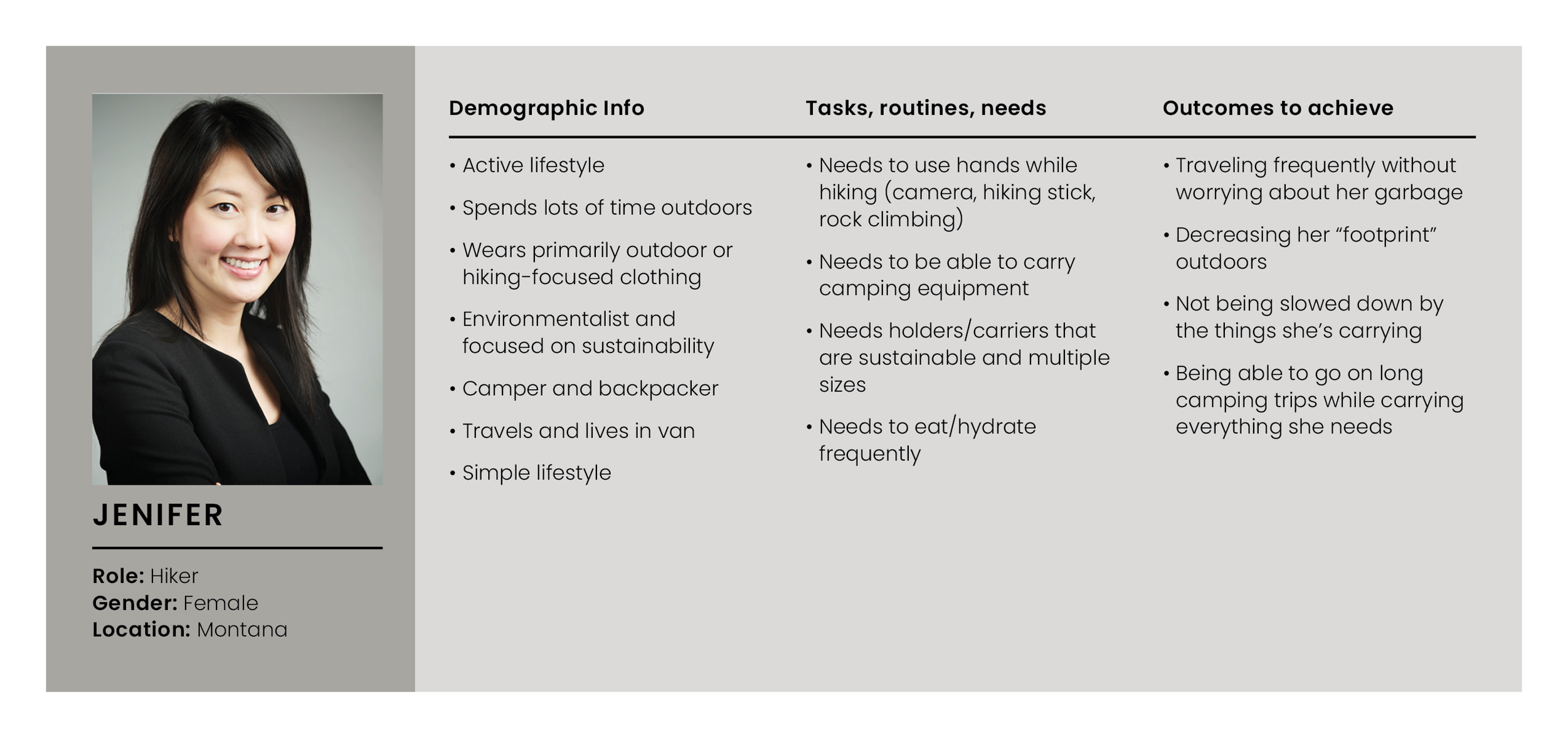
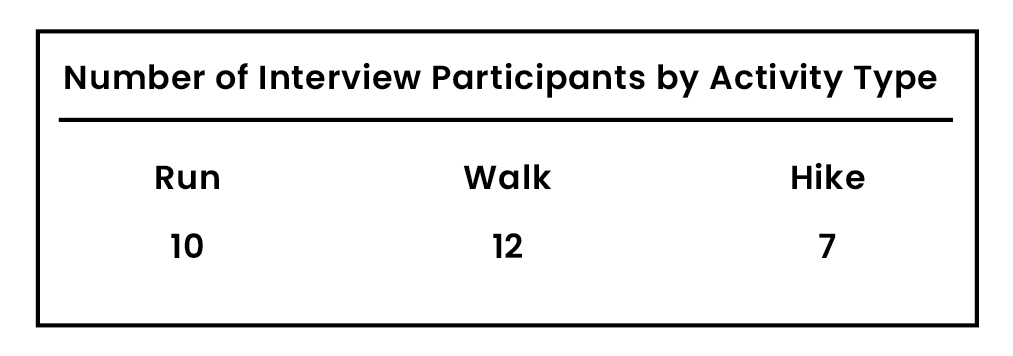
In total, we interviewed 19 individuals. Some of our participants fall under more than one category, reflected by the numbers in the table above (10,12,7), totaling more than our interview population.
Research Methods
To research what items people need the most during outdoor activities and whether we can introduce sustainable features into the design of these items, we conducted interviews. This method allowed us to learn what types of things people carry during outdoor activities and whether sustainability concerns are relevant to our user group.
Our team has interviewed 19 individuals who participate in outdoor activities such as walking, running, and hiking. Ten of our participants partake in the running category, 12 in walking and 7 in hiking.
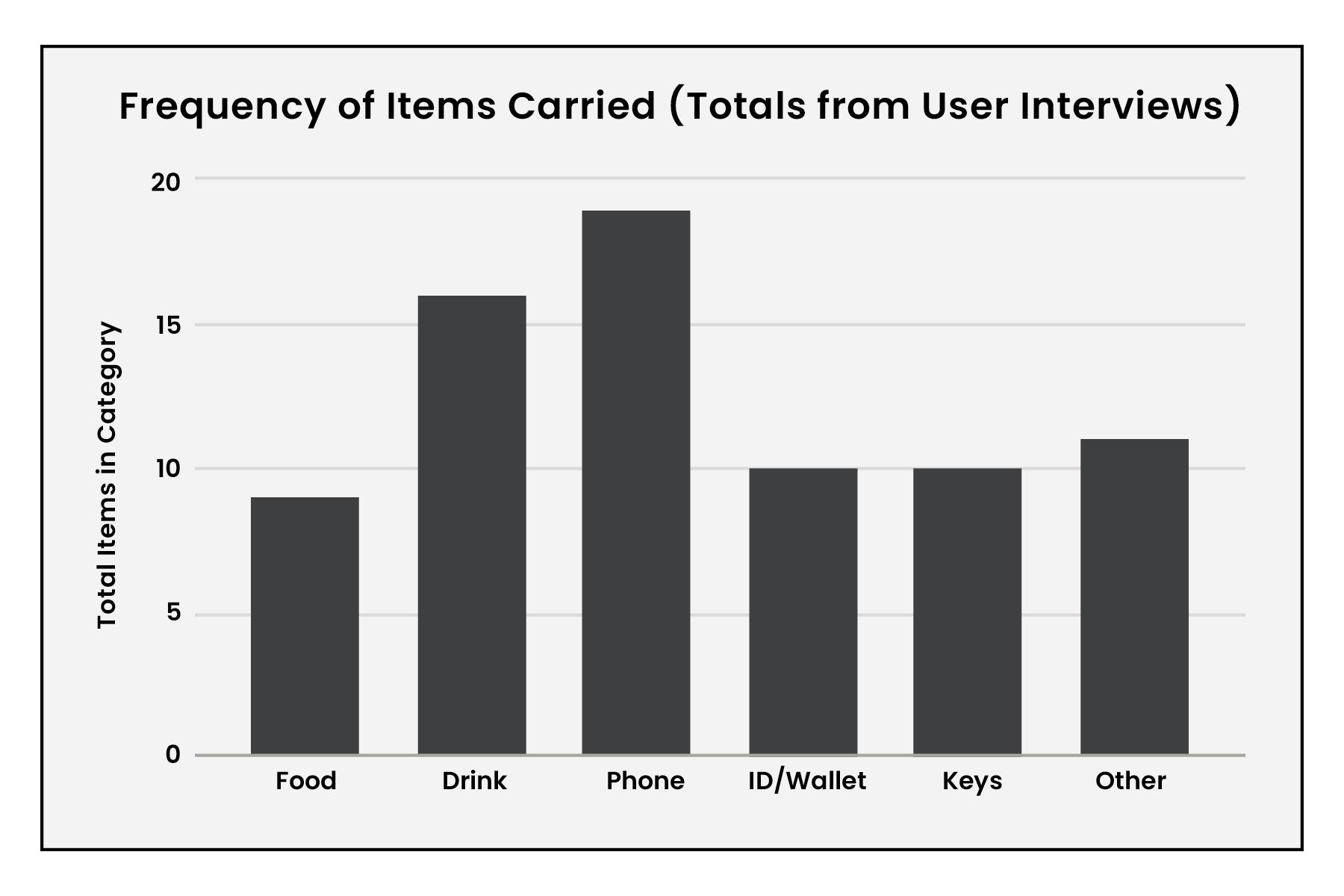
Our qualitative data included information about what types of things people carry, what functions are essential to our users in a carrier, and actions to live a more sustainable lifestyle.
To analyze our data quantitatively, we decided to pinpoint variables and quantifiable bits of information. Immediately, we could achieve this in two areas of the interviews: how much users care about sustainability and how many items they carry during their activities. We learned how many items our participants carry while doing outdoor activities and what specific items they carry by analyzing our data. In categorizing the things our users carry into six categories (Food, Drink, Phone, ID/Wallet, Keys, Other), we found that while users carry many items across the board, phones (19 of 19 users) and drinks (16 of 19 users) are by far the most popular.
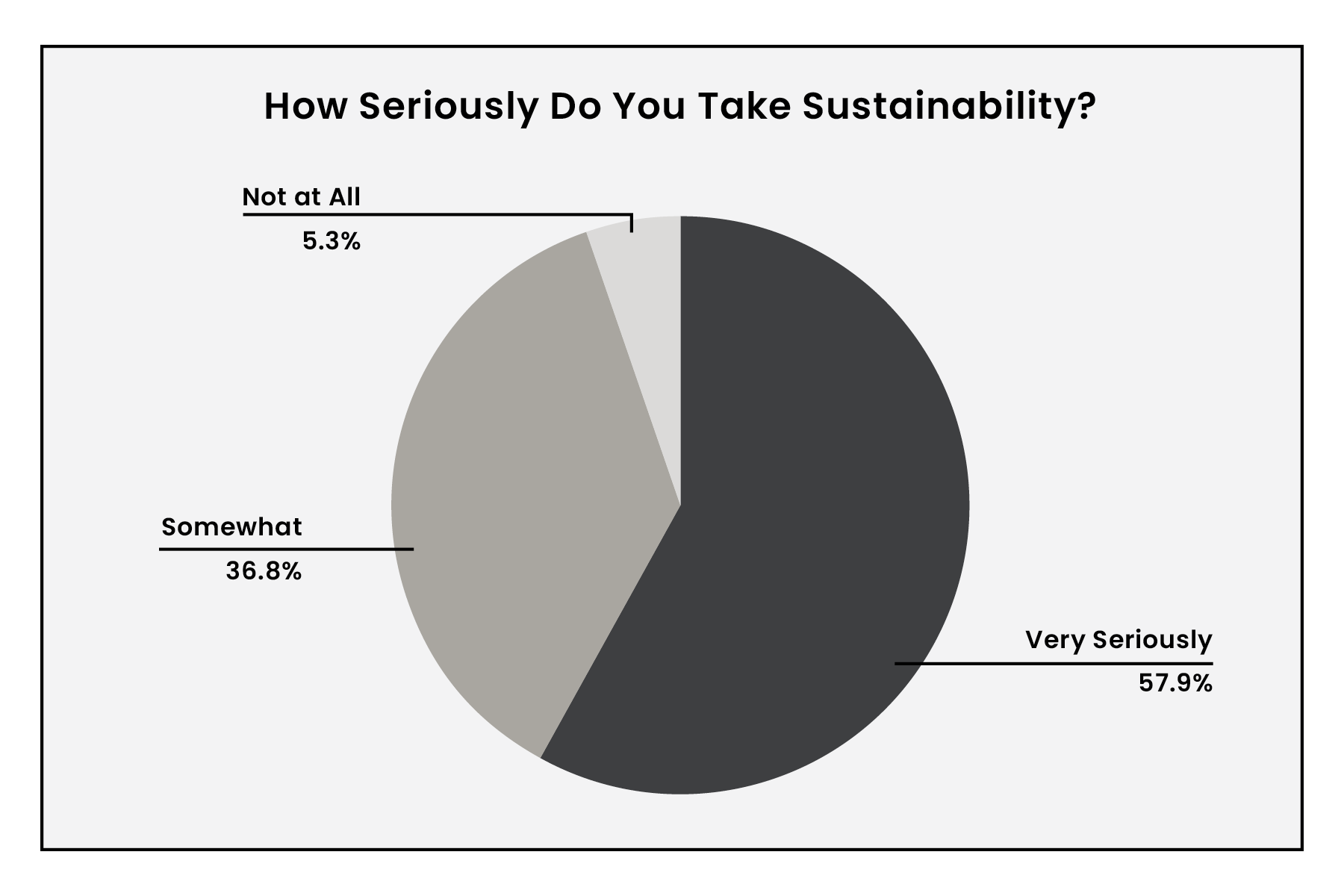
We also discovered that sustainability is important to our participants and analyzed how they value living a sustainable lifestyle. We found that most of our participants care about living sustainably, with 57.9% reporting they take sustainability very seriously. 36.8% report that they care somewhat about sustainability, and only 5.3% report that they do not care about it.
These discoveries will help us conduct further research and with developing our prototype.
Our research’s key findings support the need for participants to have a sustainable and functional way to carry items. In conducting qualitative and quantitative analysis, we discovered some interesting results that support our hypotheses of people tending to care about sustainability — including 57.9% who care very seriously — and carrying many different items while on the move during activities like phones and drinks. Participants experienced access and comfort issues while carrying items on walks, hikes, and more so, on runs. For some participants having one’s hands-free was important. As for our project’s brainstorming and prototyping portion, the data collected will be helpful from an information science perspective. Based on both the proportion of people who stated they care about sustainability and the high proportion of people who find it essential to bring along a phone and a drink, our product may focus on those two items and prioritize the other aspects accordingly. Using consumer data to improve aspects is single-handedly the most important part of making product revisions. Feedback directly from users is an excellent way to incorporate new ideas into a product, especially for physical fitness/sustainability.
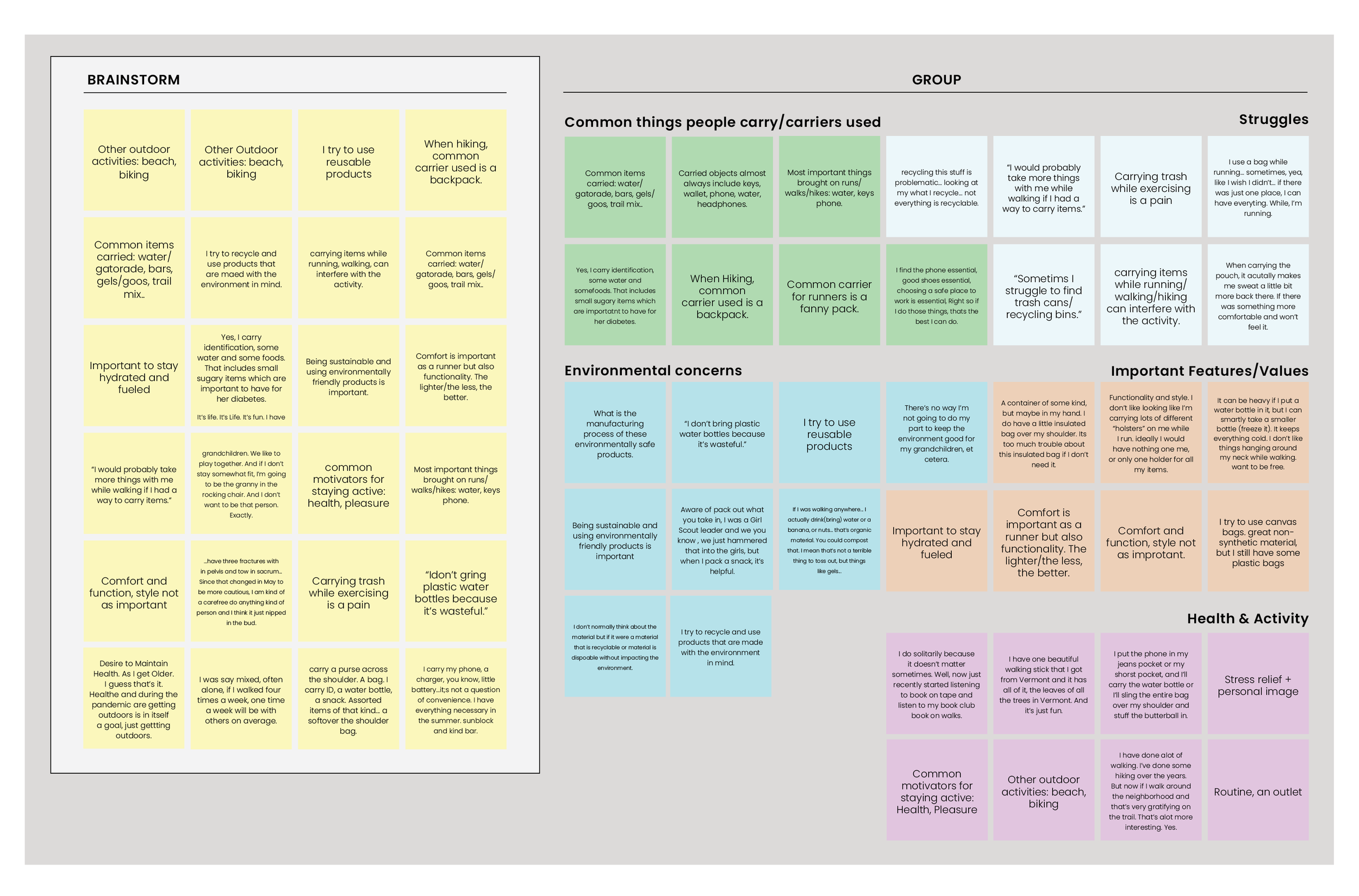
Our brainstorming process started with our team discussing as many potential features and solutions as possible to efficiently identify themes and innovative ideas.
Affinity Diagram
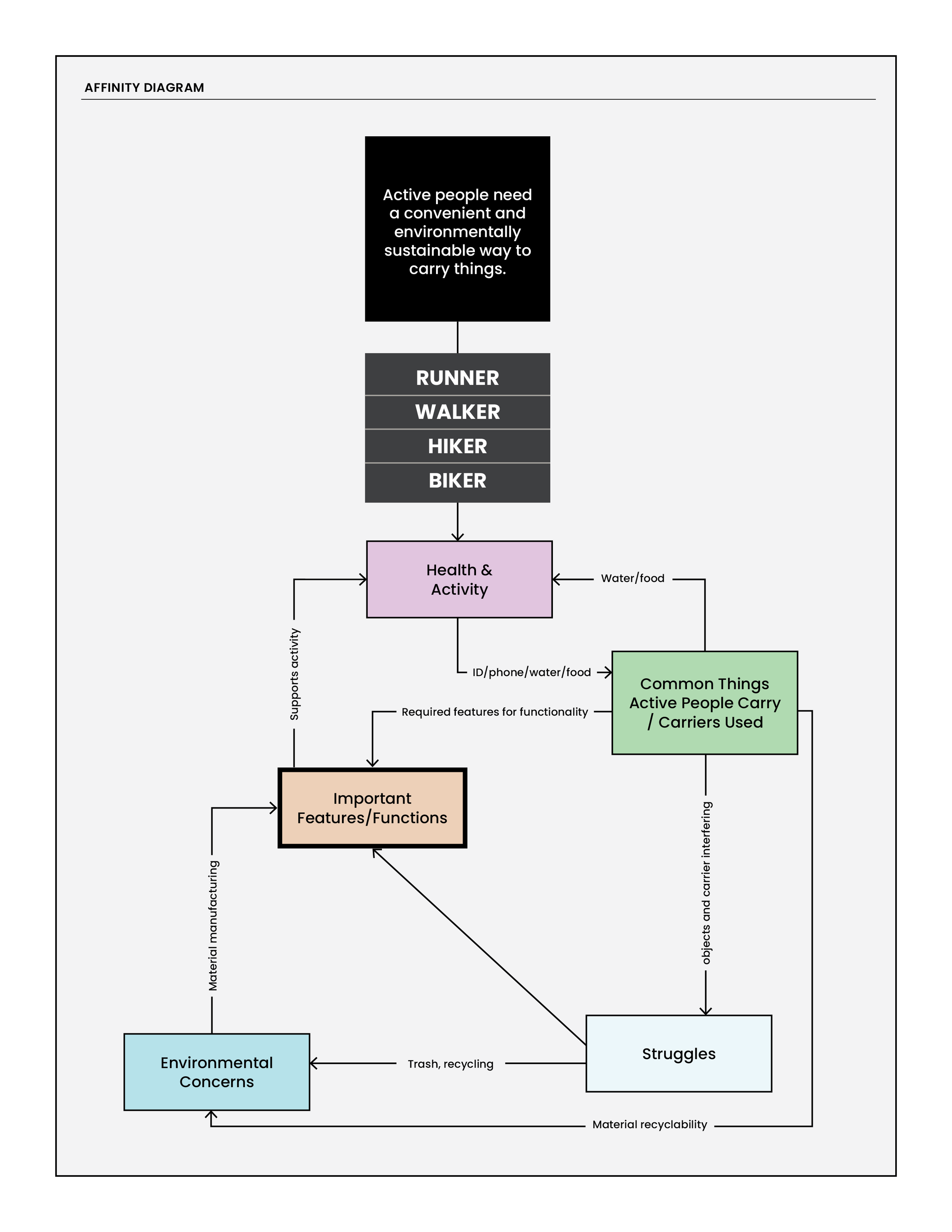
The top section of our diagram depicts the types of people who engage in everyday physical activities that we’ve categorized for our target audience pertinent to our project vision. We’ve categorized four types of people: walkers, hikers, runners, and bikers. Based on our interviews, we learned of the most common objects carried while performing physical activity and common problems encountered with the challenge of keeping essential belongings on hand while active. In addition to common struggles, items carried, and important functions, our research led to environmentally friendly ways of thinking that will influence our project and its integration with the overall idea of carrying belongings more efficiently.
Our data collection learned that our users — typically runners, walkers, hikers, bikers, and beach-goers — typically carry food, water, an ID, and a phone with them. However, these items are somewhat dependent on the activity. The Health and Activity section of our affinity diagram demonstrates how our users’ activities impact the items they carry and essential features and functions that could be valuable in an end-product. This section connects to the “Common Things Active People Carry / Carriers Used” section. Additionally, the Health and Activity section links directly to the “Important Features and Functions” section — because the activity alone will dictate some crucial features and functions that should be present in the end-product.
The Common Things Active People Carry section of our diagram represents how what people carry affects all different parts of an active person’s experience with their activity. While the group collected data, we learned that people’s types of carrying devices are fanny packs, drawstring bags, a small backpack, or nothing at all. The most common type of carrying device used by respondents was a fanny pack. The section connects to the Important Features/Functions section depending on what an active person uses to carry their items; it can change the entire experience. For example, a large backpack while running instead of a fanny pack might be able to carry more, but it will be more of a hassle to access the items they need on their run. This example works in the reverse because if a hiker used a fanny pack instead of a large backpack, they might not have the capacity to hold everything they need for their hike.
The Struggles section of the diagram represents common issues our participants reported they experienced during their activities. We learned that our users struggle with carrying multiple items while running, walking, and hiking because carrying things can interfere with their activity. We also learned that our users would choose to bring more belongings during their activities if they had a convenient way to carry them. This section connects to the Important Features and Functions section of our diagram, representing the elements users reported they find important in a carrier. We learned that our participants value comfort and functionality when choosing what to carry and do not care about style.
Our study of users related to active lifestyles, carrying items, and sustainability revealed environmental and health concerns. Common threads were users’ attitudes around recycling, environmentally friendly products, and overall ideals of lessening our environmental impact. From an ecological standpoint, they expressed a desire for more natural materials and production to produce truly recyclable and or biodegradable items instead of oil-derived plastics and textiles.
PROTOTYPE DEVELOPMENT
Brainstorming, Mockup, and Testing
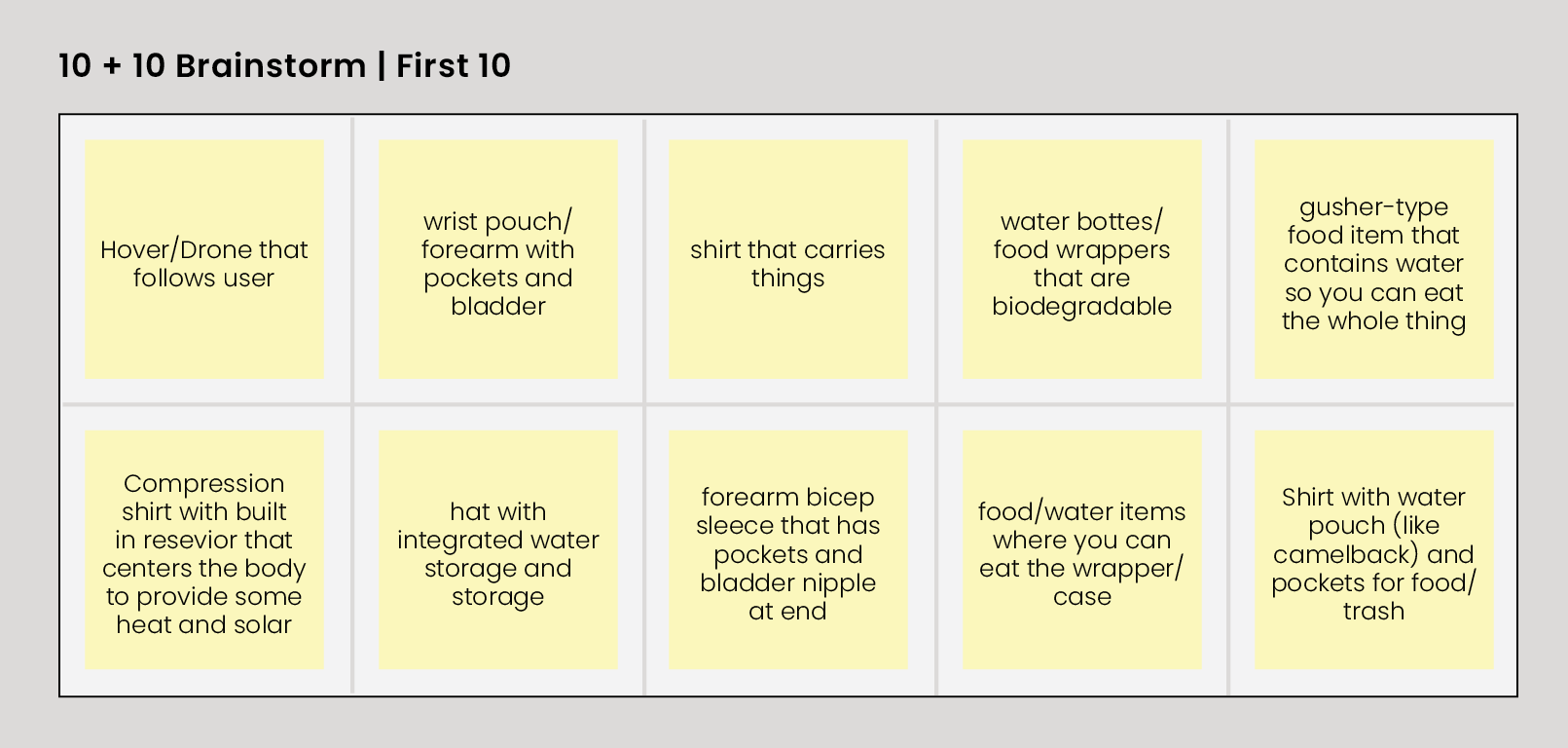
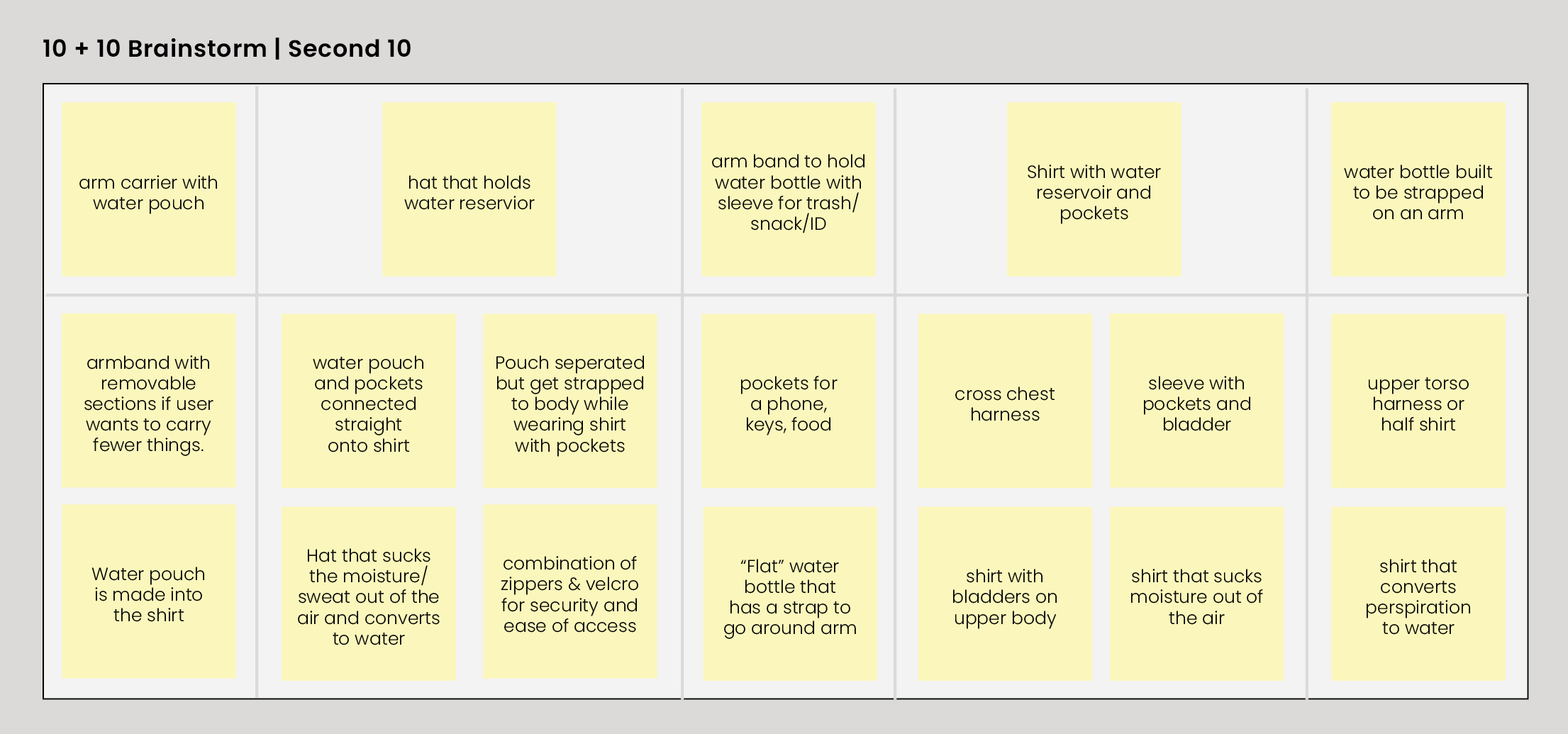
The 10 +10 brainstorm process helped us generate a range of ideas to address our problem. Some of our initial ideas explored from the first round of brainstorming were the design of apparel, biodegradable containers, and food.
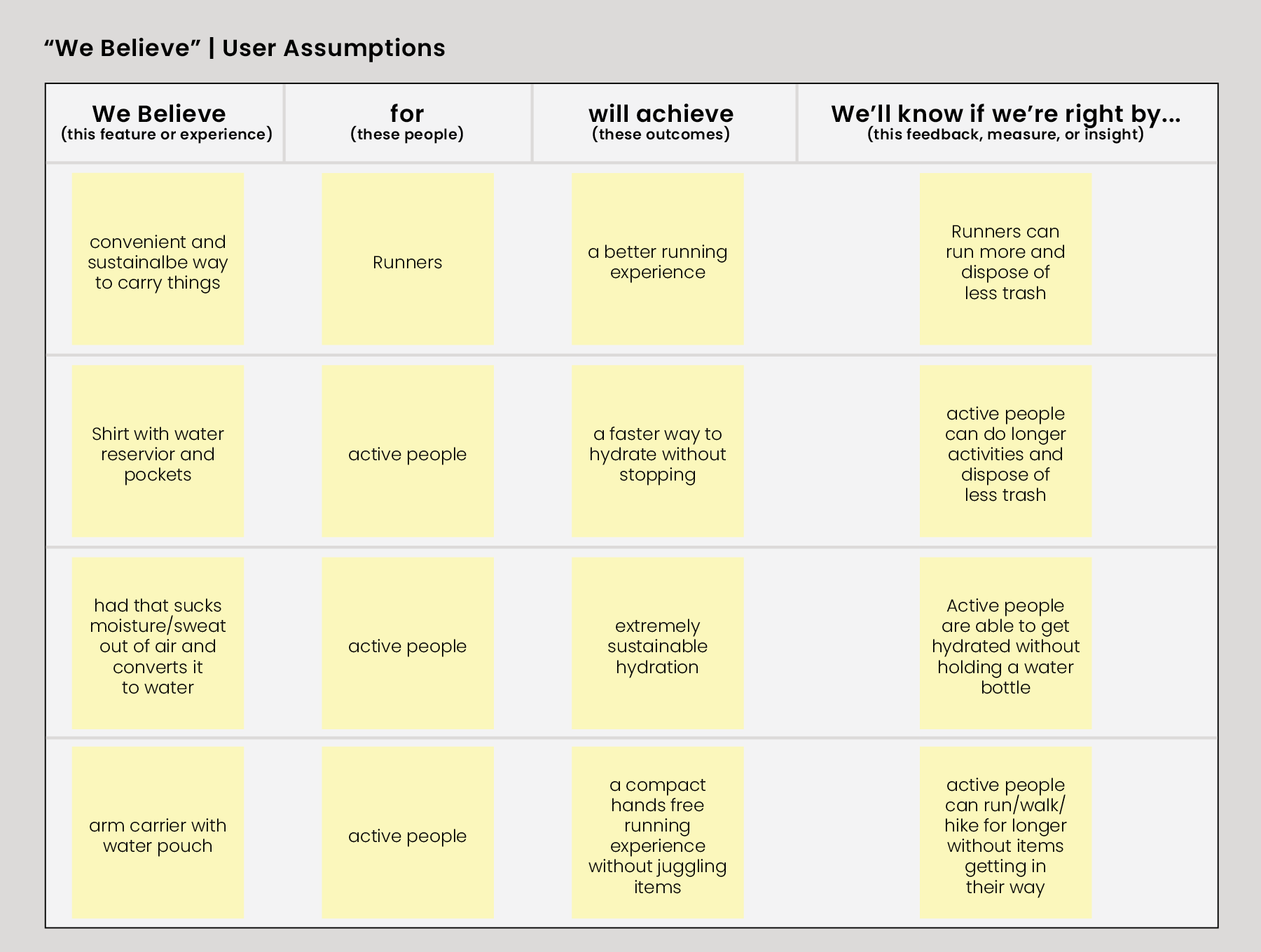
We used the "We Believe" Hypothesis statement to frame our final ideas for feedback and testing of our assumptions. Here it is essential to establish if we can prove our hypothesis. If not, we would need to revise and make sure our outcomes are clearly defined.
Make-a-thon Process and Products
Our brainstorming process started with our team discussing as many potential features and solutions as possible to identify themes and innovative ideas. In doing this, we recognized that an armband style carrier could be the best option to accomplish and include as many important features as possible while offering the best experience to a user. Once we decided on this, we looped back to the original problem from our brainstorming session to recall the grouping of user interview data into themes: common items people carry, important features and values, environmental concerns, health and activity, and struggles, our users’ specific experiences and feelings. With these in mind, we began creating a simple 2D diagram depicting the major features that we wanted our armband prototype to have. The features include pockets for keys, a phone, and a pouch for water.
This 2D prototype helped give us a basic understanding of how our product might look, work, and be helpful to our users. After creating this primary visual, we then sketched ideas to get to a more comprehensive representation of this carrier, putting deep thought into how a person will wear the armband to consider their activities, access to the features, and overall ease of use. We chose to design a band that will strap onto a person’s forearm for convenience and accessibility. Our initial approach to materials is to adopt a mesh fabric mainly around the hand and placed strategically throughout for comfort and breathability. Our goal is to create a wrist/armband with maximum accessibility lifetime use with the environment in mind composed of recyclable and biodegradable materials for end-of-life.
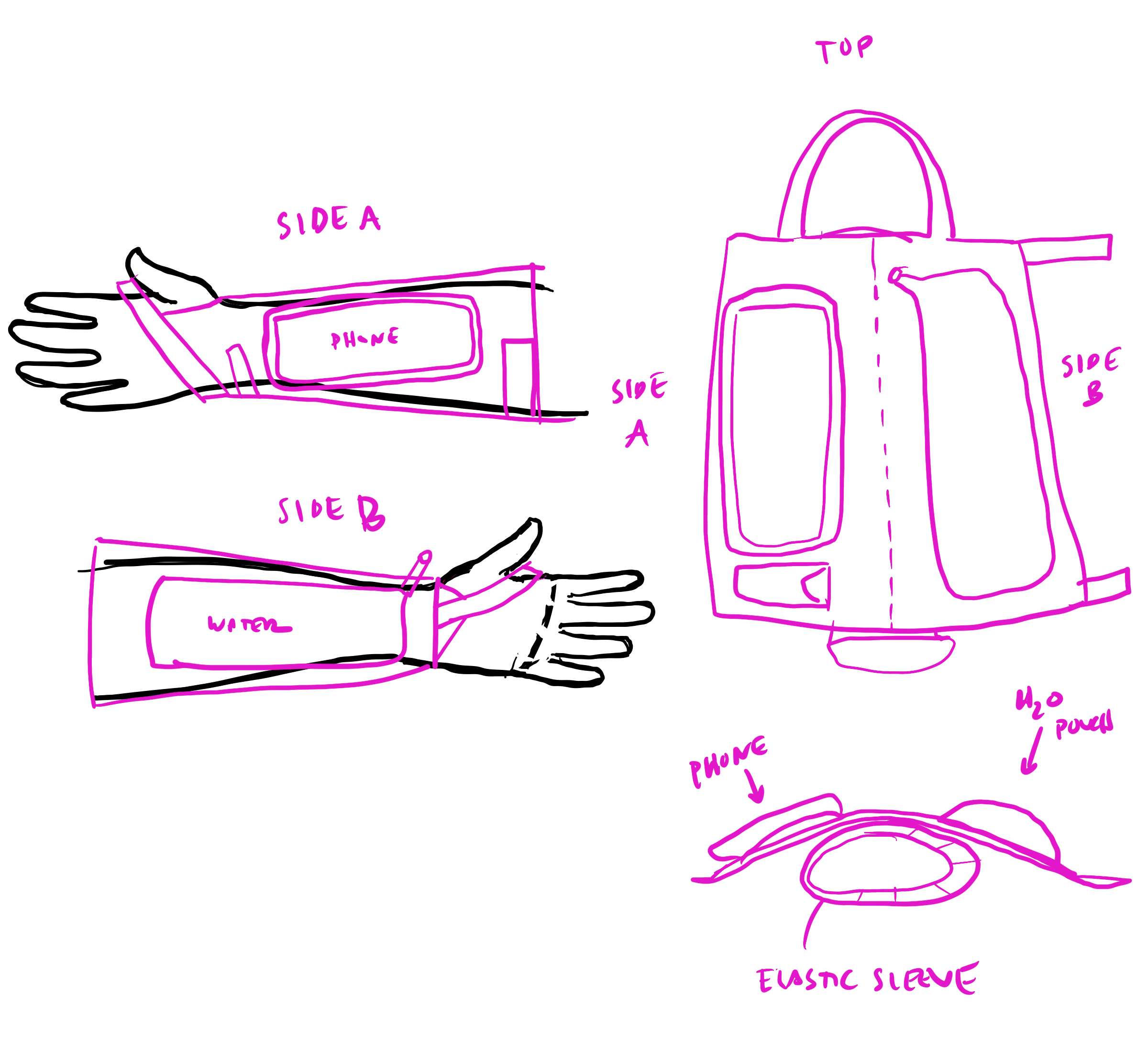
The carrier’s overarching goal is accessibility - unencumbered access to items while doing activities and overall user comfort. One key aspect of unencumbered access is the carrier provides a hands-free experience—no searching or fumbling. Hydration is accessible with a removable insert on the outer forearm. Access to the nozzle near the top of the hand and wrist allows the arm’s easy swing at the elbow to a user’s mouth. One of the main items users interact with is a smartphone. We placed the phone pouch on the inside of the band’s forearm with a transparent overlay so that the user could touch their phone screen without needing to remove the phone from the pocket. While people are in the middle of their activity, they can quickly glance at their phones without repositioning anything.
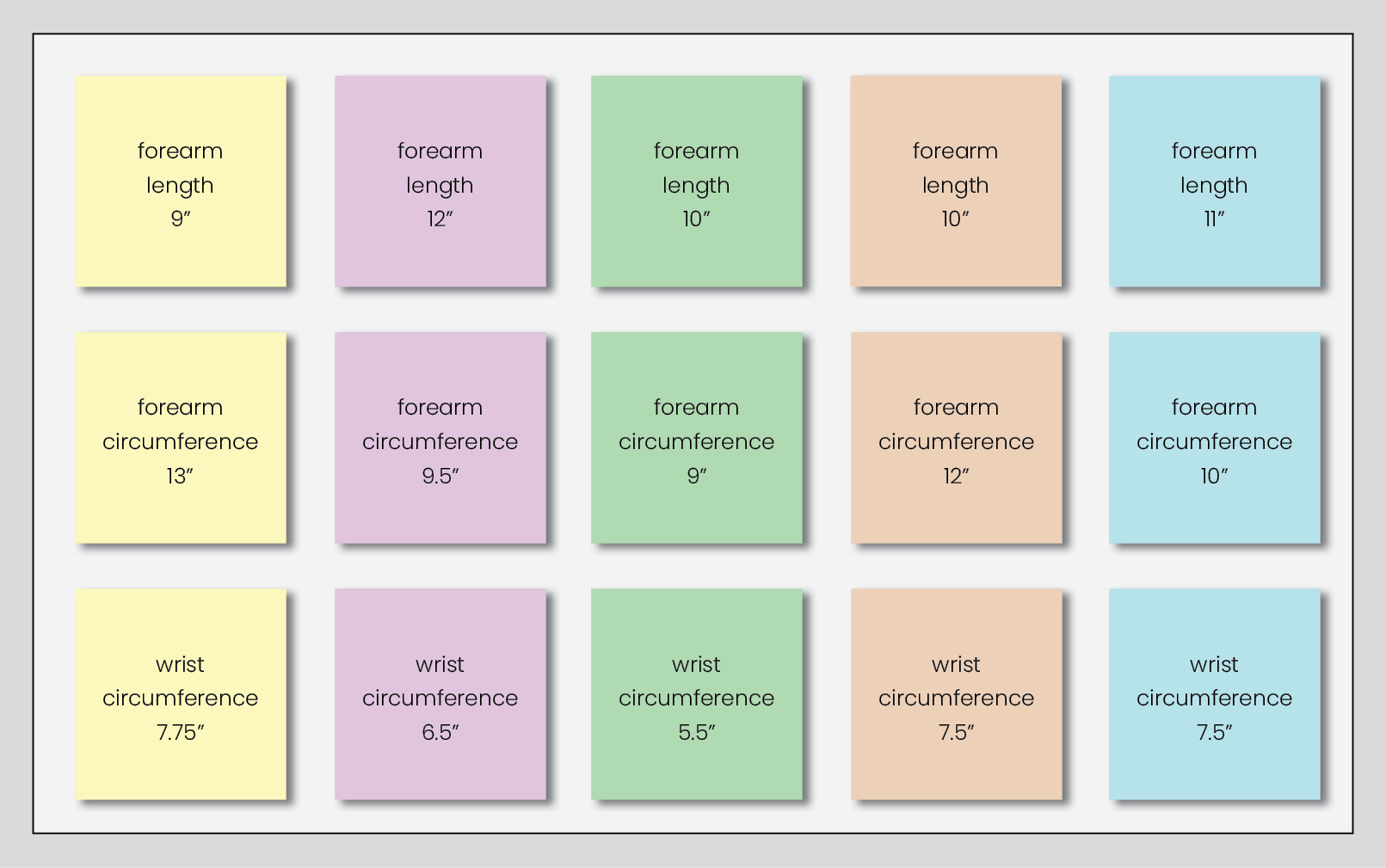
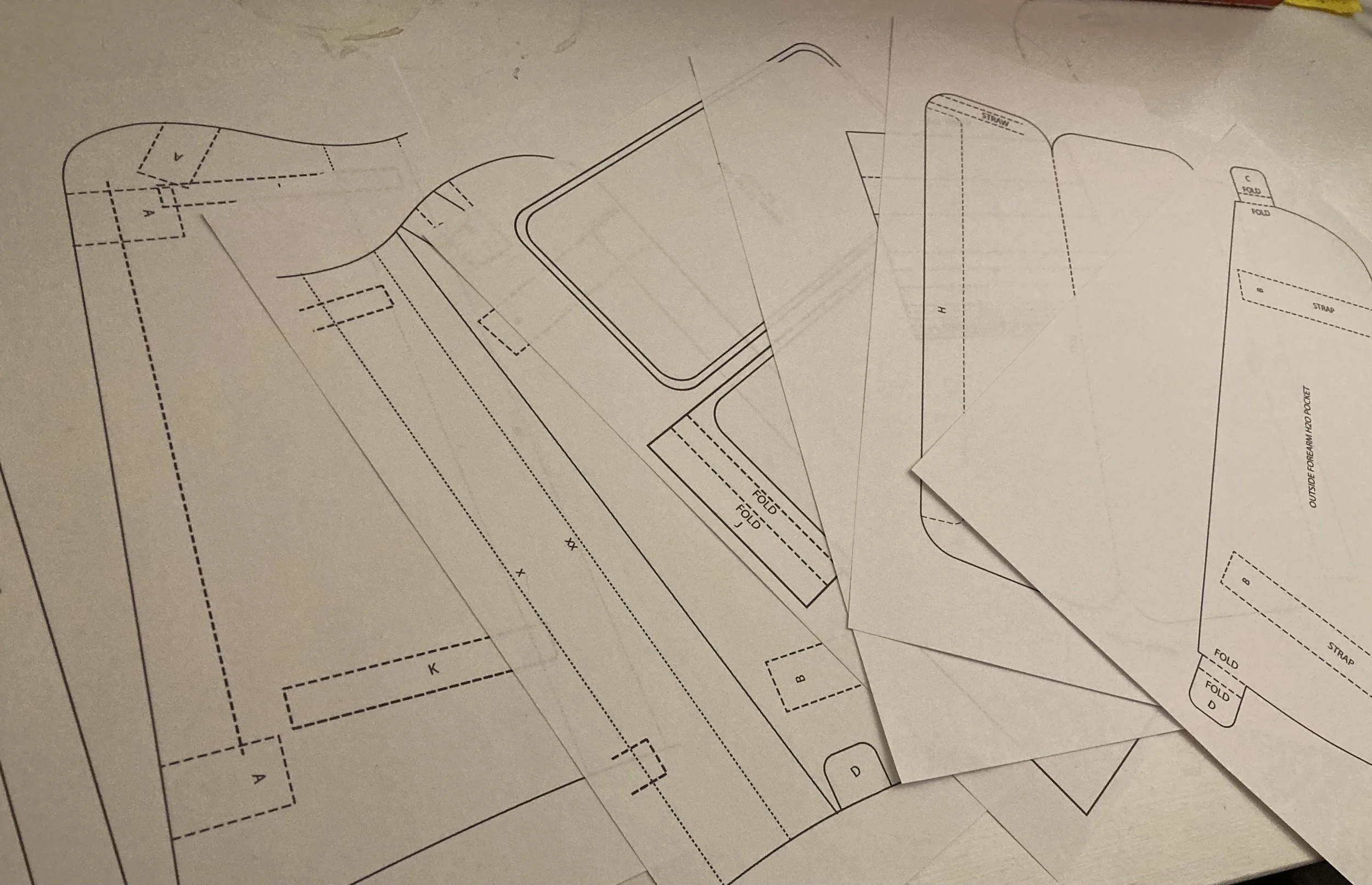
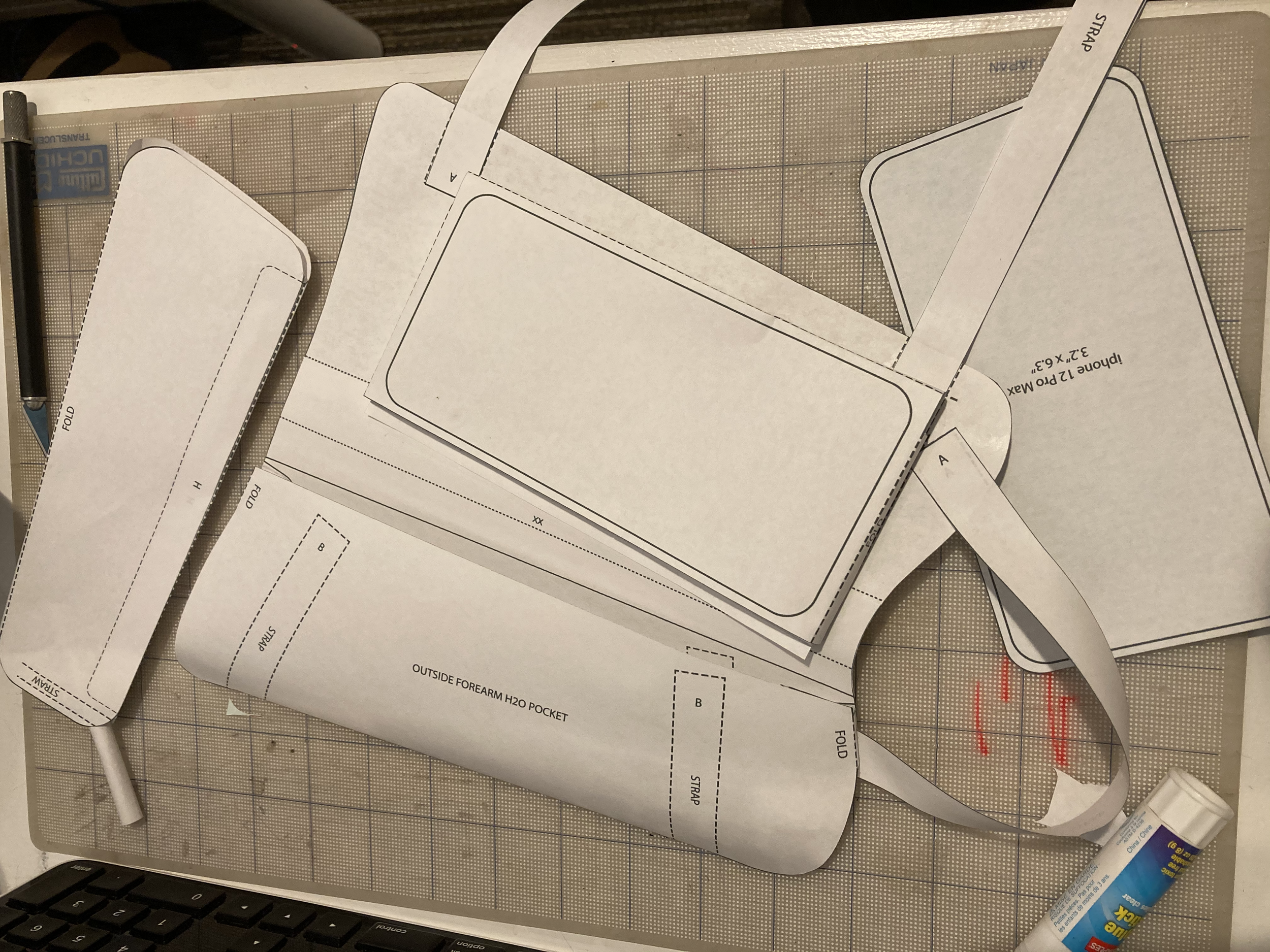
Each team member took note of their forearm length, the circumference of their wrist, and forearm to give us an idea of how to size the 3D prototype that we will create for testing with users. We explored a testable model by creating prototypes out of paper. We faced challenges with how the band would comfortably attach to the arm. How easily can the user connect the straps of the armband with one hand? We explored a combination of attaching to the wrist, around the palm, and around the thumb. We also looked at how the armband fits on the forearm. How high or how tight. We could tell that pressure points are on the forearm and wrist from the prototypes. Users’ forearm dimensions will differ, so we want to consider and provide ample adjustment. Another possible solution is to integrate an elastic sleeve as the base and attachment points built around it. The elastic sleeve could be partial or complete coverage of the forearm.
Research Question
Usability testing will focus on guiding users through use of our prototype by assessing the prototypes’ main features — water capabilities, phone carrier, carrier capacity, and the carrying experience — and how these features align with user activities.
Research Methods
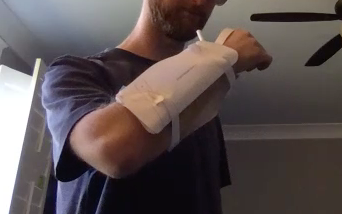
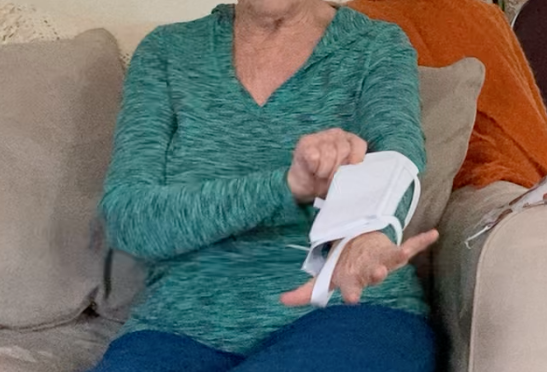
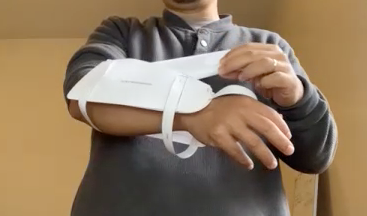
To test our prototype, we created a 3D model of an arm-band carrier out of paper. Our goal was to assess the main features of our prototype — water holding capabilities, phone carrier, carrier capacity, and the carrying experience — and how these features align with user activities. We developed a usability test plan with specific tasks we had our users perform with the prototype in order to obtain quantitative and qualitative data. The tasks included:
placing the arm-band on
interacting with it
placing items inside of it
accessing items from inside of it
and doing an activity while wearing it
Instructing our participants to complete these tasks with the prototype will help us better understand how users would interact with the product. We interviewed 13 people to test our prototype. Each member of the team tested the prototype with participants and contributed to analyzing the data we gathered through the process.
ANALYSIS
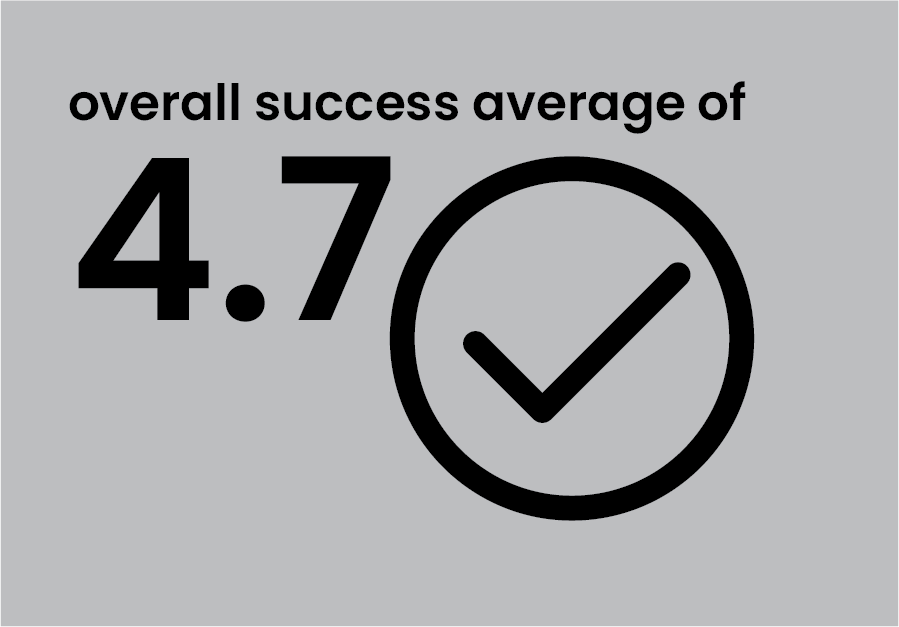
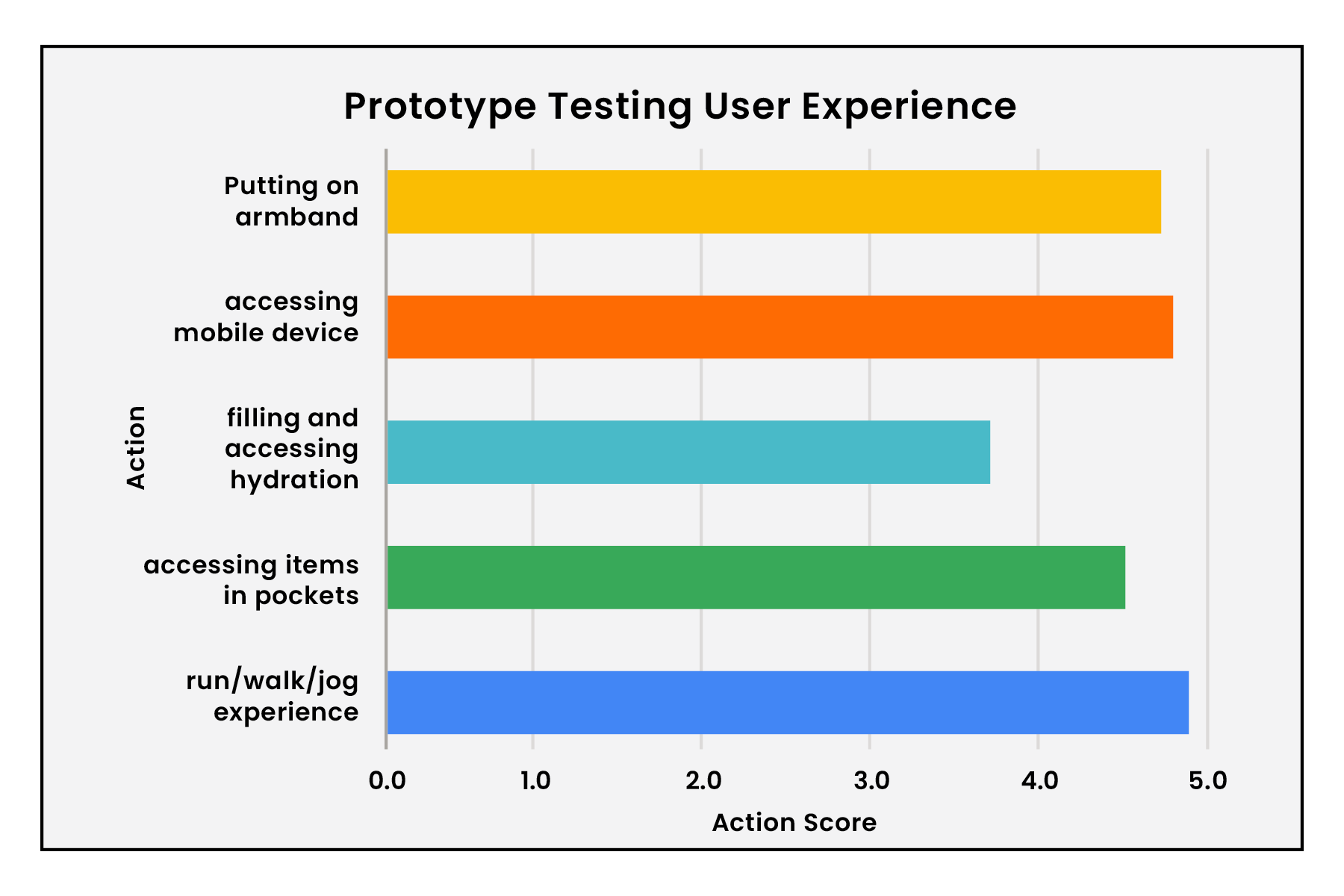
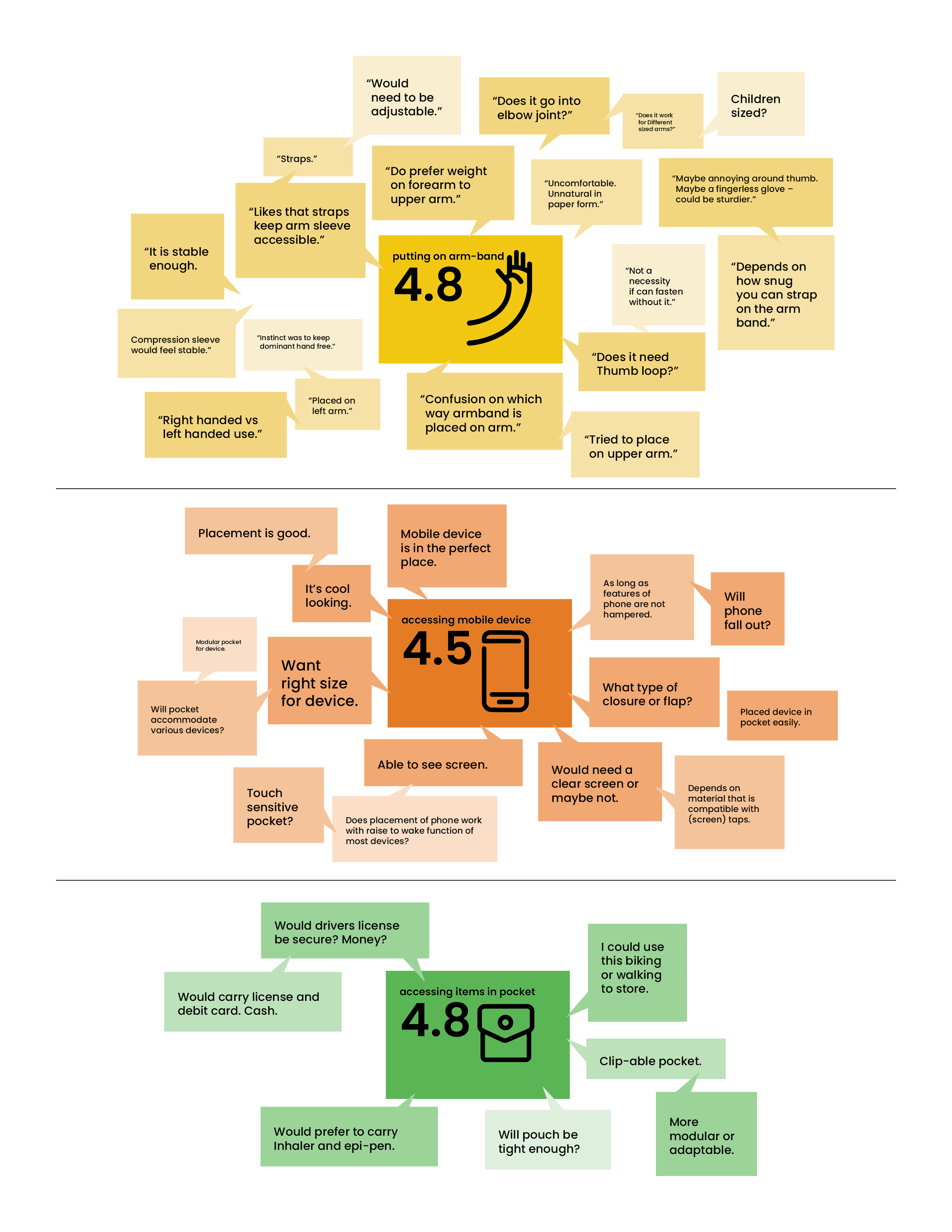
Participants were asked to rate their experience on each task using a scale of 1- not easy to 5 - extremely easy. The user experience scores show the ease of accomplishing the 5 tasks while using the prototype as mostly successful with average of 4.7 for putting on the arm-band an average of 4.8 for accessing the mobile device, an average of 4.5 for accessing items in pockets and an average of 4.8 in the Run/walk/jog experience. The task of Filling and accessing hydration scored an average of 3.7.
FINDINGS
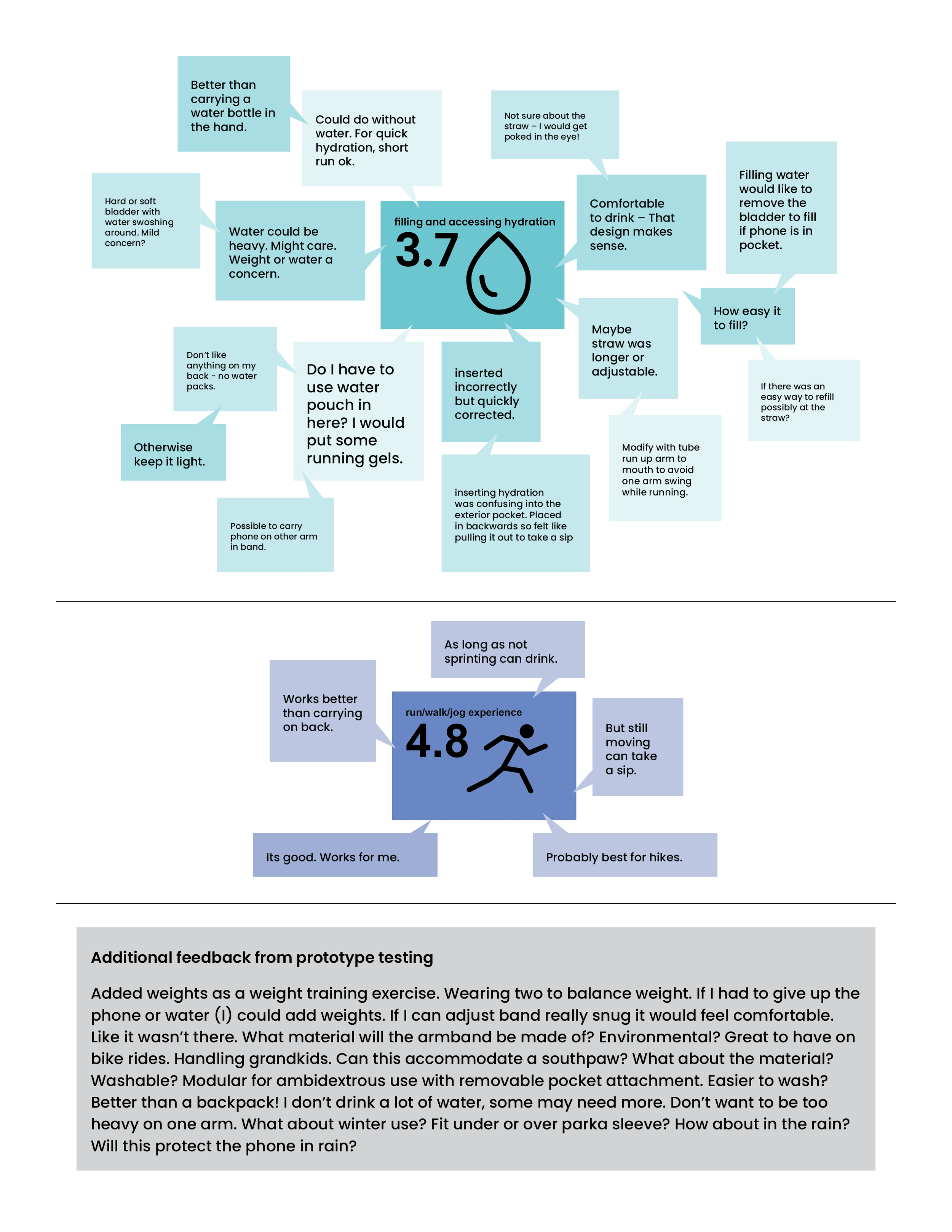
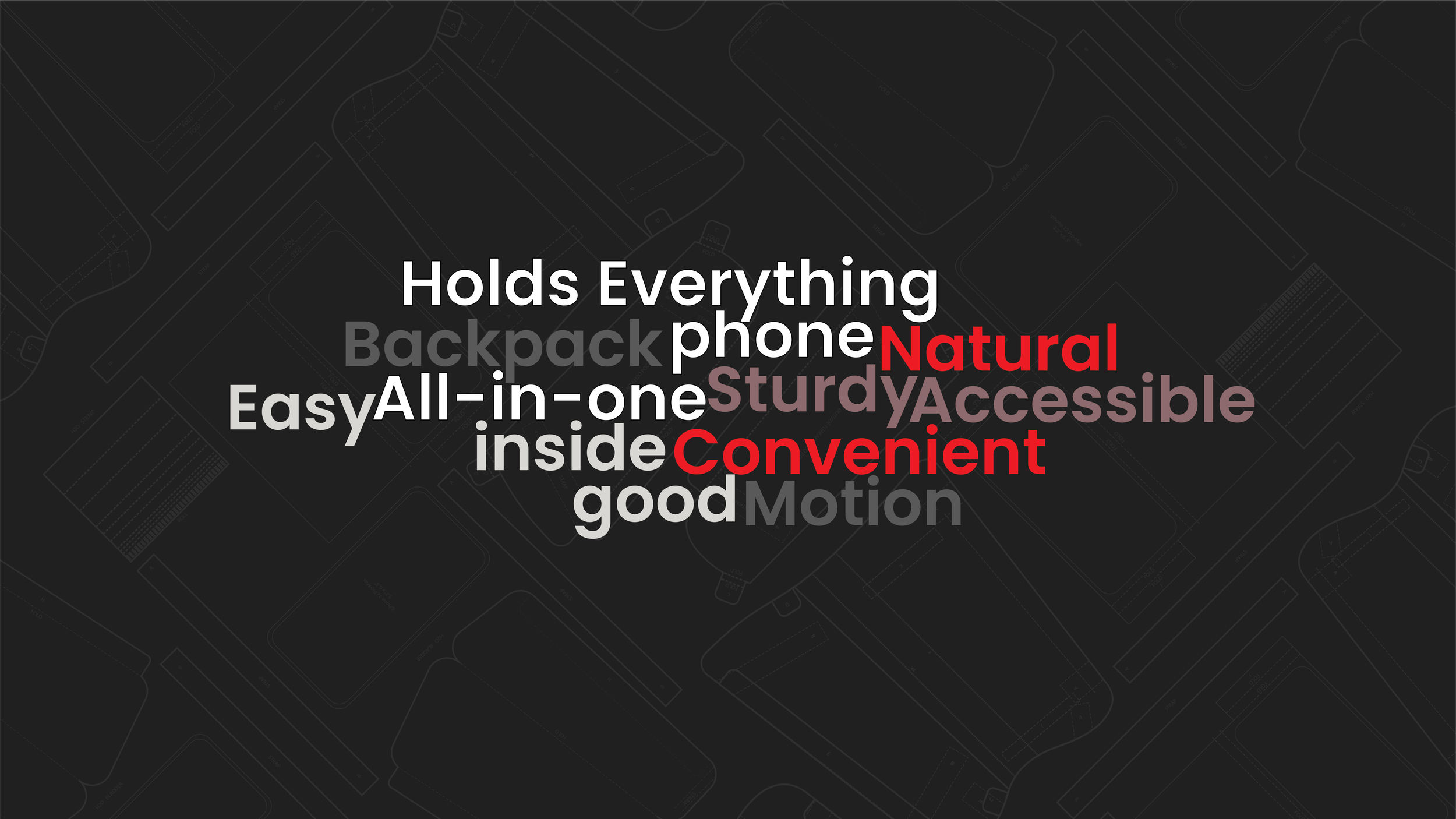
Through testing our prototype with participants, we learned that overall it would be a useful product. Our participants reported that the arm-band is easy to put on and to use.Additionally, our participants found that it was easy to interact with their mobile device while wearing the arm-band. For the water pouch, our participants reported that the weight of it could be an issue. However, participants found the other pockets in the arm-band to be accessible and capable of carrying their essential items. When we had users test jogging in place with the arm-band, our participants reported positive experiences and found that the arm-band did not feel uncomfortable.
Postive messages
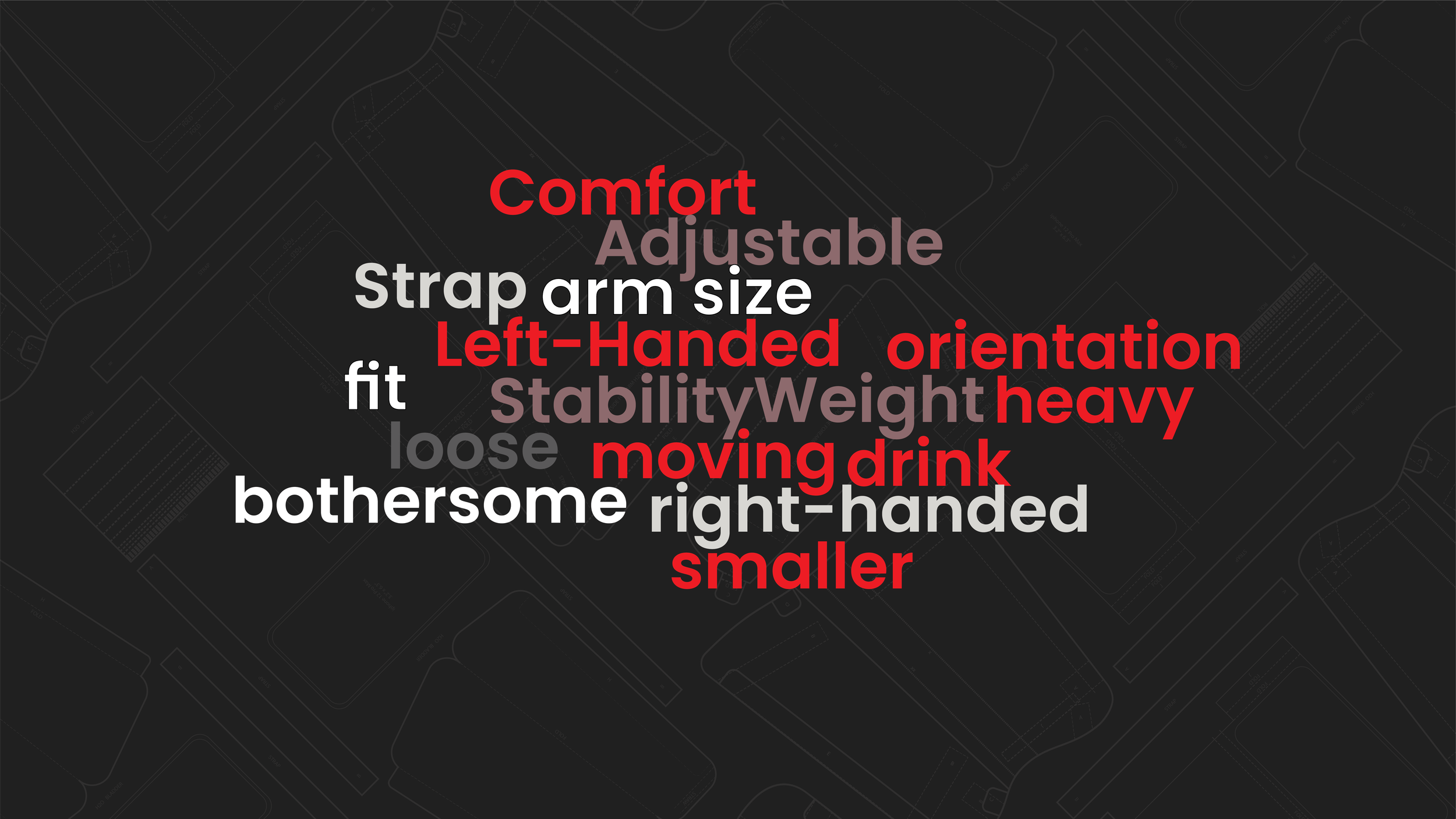
We also learned about some areas to improve on concerning the armband fit. Some participants found the straps to be too long, so to fix this we would need the arm-band to have adjustable straps so that it would accommodate more potential users. Sizing was an important issue with concerns of overall fitment. The task of interacting with a mobile device found participants also expressing concern over whether there would be a clear material over their mobile device so they can interact with it during an activity and if the raise-to-wake feature on most devices will still function. Interacting with the hydration pocket was an issue for some test subjects concerning weight and bulk. One tester suggested that it would possibly be more effective to run the water tube up the arm closer to the head and mouth. Overall users were concerned with weight with or without use of the water module.
Negative messages
Other feedback from test subjects revealed other uses for the armband. One respondent felt that space was at a premium and would remove the hydration container and use it to hold an inhaler and epipen. The same test subject also suggested that wearing two armbands with added weights could be used for strength training workout. Others in the test group suggested even wearing two armbands for more capacity.
CONCLUSIONS
Our next steps include taking the feedback — both positive and negative — that we received throughout our testing and brainstorming new ideas and ways to improve our product and revise what we already have. Another step that we could take and implement to make the prototype better is by revising the prototype and doing some additional tests to see if these adjustments made an impact. By continuously collecting feedback on what changes people would like to see, we can record this feedback and adjust our product to make it more useful for our users.
Our participants offered unique insights that could improve the product and expand on its range of use. One of our participants pointed out that it might be difficult to wear the arm band over or under a coat in winter. We would seek future exploration of our prototype to improve the strap and make sure it is adjustable for any forearm. This could mean a bare forearm or one that’s covered by clothing. The strap will fit a wide range of user arm sizes from adult to adolescent audiences. We can improve our product by making sure that the weight is evenly distributed and that it is light and comfortable. Additionally, we can make our product more appealing if it were ambidextrous. The product would be able to work on either arm or be switched if necessary. Another possible addition to our product could be to add a modular pouch or some velcro where the user can add another pocket to put useful items. And lastly, we would explore the environmental impacts of different material options in fabricating the product.